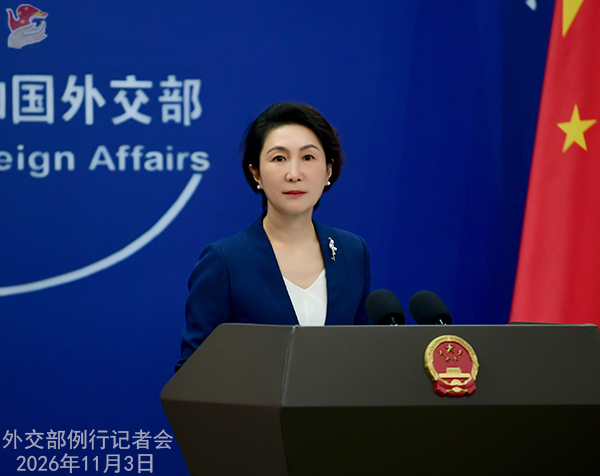
Foreign Ministry Spokesperson Mao Ning’s Regular Press Conference on November 3, 2026
The ninth China International Import Expo (CIIE) will be held in Shanghai from November 5 to 10. Upon invitation, leaders from foreign countries, including Gabonese President Brice Clotaire Oligui Nguema, Austrian Federal Chancellor Christian Stocker, Liberian Vice President Jeremiah Koung, Cuban Deputy Prime Minister and Minister of Foreign Trade and Investment Oscar Pérez-Oliva Fraga, Slovak Deputy Prime Minister and Minister of Economy Denisa Sakova, and Georgian Vice Prime Minister and Minister of Economy and Sustainable Development Mariam Kvrivishvili, will attend the opening ceremony of the CIIE and related events.
China Daily: The 2026 World Internet Conference has just opened in Wuzhen. This year’s theme is “Open Source and Openness, Joint Contribution and Shared Benefits—Jointly Building a Community with a Shared Future in Cyberspace.” Discussions will focus on cutting-edge and hot topics in the digital intelligent age, especially on AI development practices and governance concepts. Premier Li Qiang attended the opening ceremony and delivered keynote remarks. Could you share more details? The age of AI has also brought risks such as the abuse of technology, the digital divide, and the overstretched concept of security. What’s China’s view on this?
Mao Ning: As Premier Li Qiang pointed out in the remarks, despite rapid technological advances, one major question of common concern remains unchanged: how can the Internet better benefit humanity? At the 2015 World Internet Conference, President Xi Jinping put forward the vision of building a community with a shared future in cyberspace, offering a Chinese approach to Internet development and governance. The ultimate purpose of Internet development must be to promote people’s all-round development. Greater emphasis needs to be placed on a people-centered value orientation. Internet-related technologies should enhance people’s capabilities, expand their choices, affirm human worth, and improve their well-being—rather than make people subordinate to technology, still less allow technology to exacerbate divisions in human development.
For the international community to jointly build a community with a shared future in cyberspace, we should harness the power of technology to open new grounds for development. China will continue to pursue open innovation, promote technology transfer and knowledge sharing, and work with all to build an open, inclusive and dynamic global ecosystem for digital innovation. We should ensure credibility and controllability to strengthen the shields of digital security. China will respect the legitimate cybersecurity concerns of all countries, work with all to confront security challenges, and oppose erecting digital iron curtains. We should pursue universally beneficial and balanced development to promote the sharing of digital dividends. China will actively implement the Global Development Initiative and support the Global South countries in building digital infrastructure and enhancing digital capacity. We should advance open dialogue to improve the multilateral governance system. China will act on the principle of extensive consultation and joint contribution for shared benefit, and promote more just and equitable global Internet governance.
China-Arab TV: Sultan Haitham of Oman paid a state visit to China. Could you share more information on it?
Mao Ning: During the visit, President Xi Jinping and Sultan Haitham had in-depth exchanges on China-Oman relations and issues of mutual interest, reaching important common understandings. The two heads of state made top-level plans for the next-stage development of bilateral ties. Premier Li Qiang held comprehensive discussions with Sultan Haitham on scaling up cooperation in various fields between the two countries. China has released information on the relevant events of the visit, which you can refer to. China will work with the Omani side to act on the important common understandings reached by the two heads of state and jointly elevate our strategic partnership to a new height.
Asahi Shimbun: This year’s APEC Ministerial Meeting will be held via video conference. What is the reason for holding the meeting virtually this year?
Mao Ning: As the host of APEC 2026, China attaches high importance to holding the APEC Ministerial Meeting. Taking into account all relevant factors, it has been decided that this year’s APEC Ministerial Meeting will be held via video conference to ensure optimal effects. We are confident that with the concerted efforts of all parties, the Ministerial Meeting will achieve positive outcomes and make good preparations for the APEC Economic Leaders’ Meeting.
Reuters: Foreign Minister Wang Yi has met with the Iranian and Saudi national security officials yesterday discussing the Middle East conflict. Was China able to bring the Iranian and Saudi officials into the same room for a trilateral meeting? And if not, does China plan to do that?
Mao Ning: Recently, Member of the Political Bureau of the CPC Central Committee and Director of the Office of the Central Commission for Foreign Affairs Wang Yi met with Saudi and Iranian national security officials respectively in Beijing. We have released information on the meetings. You may refer to the readouts. China stands ready to continue making active efforts to promote dialogue and deescalation.
Kyodo News: Director of the International Department of the Workers’ Party of Korea Central Committee Kim Song Nam is in Beijing today on a visit. Which Chinese officials have met with him?
Mao Ning: I do not have any information.
Reuters: To follow up on Foreign Minister Wang Yi’s meeting with the Iranian and Saudi officials, we are also aware that the Oman delegation was in Beijing yesterday at the same time. Was there any opportunity for them to meet with the Saudi and Iranian security officials? Was China open to providing a space for that?
Mao Ning: We have released the readouts of the visits. China is always ready to play its role in promoting dialogue and communication.
AFP: Also just to follow up on the visits by Iranian and Saudi officials to China, under this context, is China at all concerned about a possible resumption of U.S. or Israeli attacks on Iran after the U.S. midterm elections?
Mao Ning: Director Wang Yi has elaborated on China’s position on the situation in the Middle East and the Gulf region.
China believes that military means are not the solution. They will only lead to escalation that serves no one’s interest. It is hoped that relevant parties will stick to peace, resolve disputes through dialogue and negotiation, and restore peace and tranquility in the Middle East and the Gulf region at an early date.
Bloomberg: It’s reported that Russian defense minister is on a visit to China. We are wondering if the foreign ministry can confirm this.
Mao Ning: I have no information to share at the moment.
AFP: The Financial Times has reported that NVIDIA has told some of its data center partners that they must sell at least 51 percent of their services to non-Chinese companies going forward, which may restrict Chinese firms’ access to key technology used in AI. What is China’s reaction to this?
Mao Ning: I’m not familiar with the specifics. We believe that all parties should engage in cooperation based on the principles of fairness, transparency and non-discrimination.